
Pestorius Sweeney House
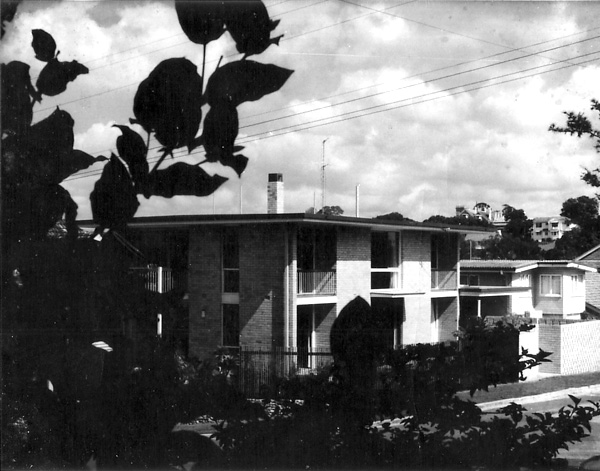
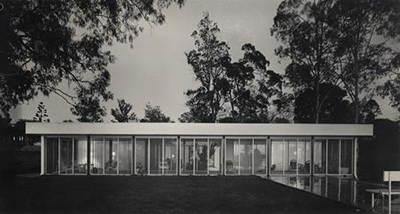
Drewe & Pestorius, Sweeney House (1966)
photo: Gabriel Poole, 1967.
History
The Sweeney House was designed in 1965 by Geoff Pestorius (1930-1968), of the Brisbane architectural firm Drewe & Pestorius, for his brother-in-law Robert Sweeney. The two-level brick construction is a fine example of post-war domestic architecture in the International Style, its blocky 'minimal' form a unique synthesis of influences including the Bauhaus teachings of Mies van der Rohe, the Californian modernism of Neutra and Eames, traditional Japanese house and garden design, and the pioneering local architecture of Hayes & Scott. Since 1999, the Sweeney House has been the site for a wide variety of art, architecture and music projects initiated by David Pestorius, the architect's son. This enterprise has been conducted under the name 'Pestorius Sweeney House'.
Current Project
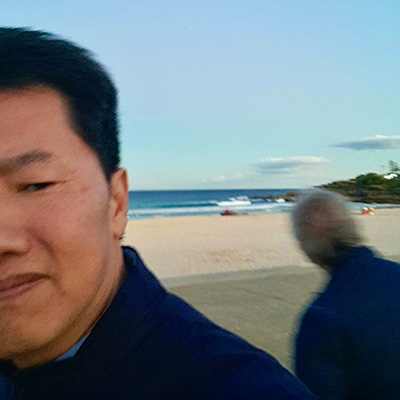
Paul Bai (curated by Nicholas Tsoutas)
1+1: Dirk Yates (Speculative Architecture)
19 August — 7 October 2023
Pestorius Sweeney House, Brisbane
We are pleased to announce a new exhibition by Brisbane artist Paul Bai, who has shown his work regularly at the Pestorius Sweeney House now for over 20 years, most recently in 2020.
Bai's latest exhibition features only four works. Selected from the artist's studio by former Institute of Modern Art director, Nicholas Tsoutas, this limited selection serves to isolate and highlight Bai's key work groups: the black double-dots titled 'The Infinite Distance Between Two Points', which are here presented in the form of a framed limited edition print; the perceptually challenging horizon works that are more commonly realised on paper, either as drawings or prints, but in this instance we have a painting on a shaped plywood support; and last but not least the paintings with thin pine frames that seem to be in the process of breaking free from their more customary moorings.
To the extent that this is a representative sampling of Bai's studio practice, the exhibition is a survey of sorts. In his short text for the exhibition, Tsoutas writes that "Bai’s painting seems to explore a third spatial moment or position between conventional spatial dialectics, such as inside and outside, up and down, here and there, abstract and physical, virtual and actual, both in his systematic simplicity of forms and his attitude of precision in the use of geometry, space and proportion." The curator is undoubtedly correct in this brief summation of what the artist seeks to achieve. However, to get a real sense of what is at stake here a visit to the show, where the Tsoutas' erudite musings will be available to read, is necessary.
Paul Bai was born in Tianjin, China in 1968. He migrated to Australia in 1988 and studied at the Queensland College of Art, where today he is a popular and influential lecturer. The artist's exhibition practice includes institutional solo exhibitions at Sydney's 4A Centre for Contemporary Asian Art and Brisbane's Institute of Modern Art. He has also had work in numerous important thematic and survey exhibitions, including at QAGOMA, ACCA, Singapore Art Museum, Guangdong Museum of Art and the Museum of Brisbane, while next month, QAGOMA will present a recently acquired double-dot work in Living Patterns: Contemporary Australian Abstraction (23 September 2023 – 11 February 2024).
In addition to the Paul Bai exhibition, we are presenting the third in our series of 1+1 displays, which see local architects activating the narrow passage behind the stairhall gallery by pairing one of the original 1965 working drawings for the Pestorius Sweeney House with a vintage photograph of it. The new display by Dirk Yates of Speculative Architecture builds on those of his predecessors in the series (Jason Haigh and Larry Weston), highlighting the honeycomb brick wall that wraps the courtyard, its perforations subtly echoing the proportions of the recessed voids of the two-level house behind.
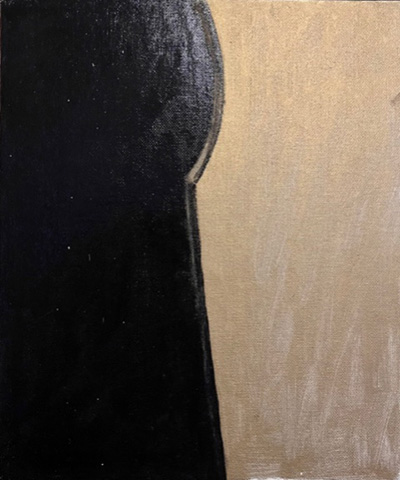
Brett Colquhoun
1+1: Larry Weston (Larry Weston Architect)
22 April – 16 June 2023
Pestorius Sweeney House, Brisbane
We are pleased to announce a solo exhibition at the Pestorius Sweeney House by Melbourne artist Brett Colquhoun (*1958).
For his exhibition Colquhoun will present artworks from his 'Access' series in the dramatic double-height stairhall gallery. First exhibited at Melbourne's important Pinacotheca Gallery in March 1991, these materially diverse works are marked by an intriguing compositional reduction that's based on a stylized image of a keyhole. Verging on the abstract and betraying Colquhoun's early study of graphic design, their skewed and disorienting viewpoints propose a vast reflective space both in front of and behind the picture plane.
In commenting on the Pinacotheca exhibition in the Weekend Australian newspaper the respected artist/critic Robert Rooney observed that these enigmatic images are "neither wholly abstract nor figurative in extreme" but "strangely evocative". Rooney also noted a "special magic” that he didn't elaborate on although it's not far-fetched to suggest that the strong presence of gold had something to do with it. Recalling the halos of early Christian art, Colquhoun's golden hues, however, seem to be saying that what's magical here is not so much the sacred light of God within the image but the secular space of the viewer and their imagination; that's the key.
It is also worth noting that Brett Colquhoun has a significant yet not widely known connection to Brisbane. In the early 1980s, the artist developed an enduring friendship with co-founder of The Go-Betweens', Grant McLennan, who introduced him to the artist John Nixon, who in turn agreed to host Colquhoun's first solo exhibition at his famed Art Projects gallery in late 1982. And so began an exhibition practice that now spans more than four decades.
Complimenting the Colquhoun exhibition is the second in our series of 1+1 displays, which see local architects invited to activate the narrow passage space behind the stairhall gallery with one of the original 1965 working drawings for the Pestorius Sweeney House and a vintage photograph of it. The new display is by Larry Weston, who is best known for his work over the last 30 years designing the cafes, factories, and retail outlets of the Merlo Coffee enterprise.

Jan Timme: Without memories, without plans.
1+1: Jason Haigh (Cloud Dwellers)
28 January – 25 March 2023
Pestorius Sweeney House, Brisbane
We are excited to announce two new exhibitions to open concurrently at the Pestorius Sweeney House.
The first, in the central stairhall gallery, sees the return of Berlin artist Jan Timme (*Stuttgart, 1971) who will also activate the carport as part of his exhibition. In the 1990s, with the addition of a roller-door, the carport morphed into a garage and in recent years it has played host to a hard-edge painting from 1969 by Brisbane artist Nevil Matthews (1930–2013). A photograph of this space, which is only illuminated by natural light from a narrow opening on the western side, is reproduced on the artist's printed announcement. For the duration of his exhibition, Timme will replace the Matthews painting with one of his new black works. These laboriously created objects are comprised of numerous narrow timber slats, which are glued together, side-by-side, to form a panel. The front surface is then heavily sanded and coated in a dark oil stain, a process that brings out the natural shapes in the wood. At the same time, the formal striped construction loosens its grip on the 'all over' while fleeting refractions of light register across the surface. Timme's exhibition title 'Without memories, without plans.' is another manifestation of this, evoking as it does the collapse of time in art since Minimalism in the 1960s, something the artist's disorienting 'fractal' piece for the stairhall so dramatically embodies.
The second exhibition will be sited in the narrow passage behind the stairhall and initiate a series of solo displays titled 1+1 by local architects, who've been invited to select and juxtapose one of Geoffrey Pestorius' exquisite drawings for the Pestorius Sweeney House with a vintage photo of it. The relationship between the two items may be obvious or obscure, while the narrow space and ambulatory experience of the displays could also hold a clue. The first display is by Jason Haigh of Cloud Dwellers architects.
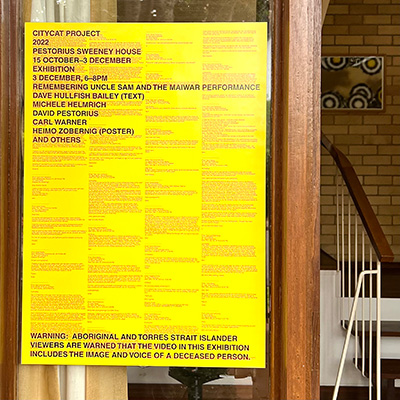
CityCat Project
15 October – 3 December 2022
Pestorius Sweeney House, Brisbane
It is with mixed emotions that we announce the first exhibition of the CityCat Project (CCP) since the passing in 2019 of its visionary protagonist, Uncle Sam, whose family has authorized this form of posthumous naming and the continuation of the enterprise.
A complex ongoing collaboration, but mainly with Los Angeles artist Dave Hullfish Bailey (*1963), further announcements regarding the future of the project, including the management of its central component, the Maiwar Performance, will be made in due course. For the moment, Uncle Sam's family agree the focus should be on those photo, graphic and collage works which reflect on the power and majesty of Maiwar (the Brisbane River) as embodied in the great flood of January 2011.
These works, which are increasingly prescient today, continue the pattern of call-and-response between Uncle Sam and Bailey, and mostly spring from conversations between the two artists leading up to the Maiwar Performance in 2019. A comment to Bailey, "water is trying to reclaim their dreaming pathways", underscores the spiritual dimensions and the political agencies of flooding rivers. Perhaps it also holds up a mirror through which to view Uncle Sam's own activism and his expanding goals for the CCP.
The works here create a critical frame through which to consider the prior question, "reclaim the pathways from what, exactly?" They emerge through Bailey's explorations of Queensland Globe, the government-run website in which historical land surveys and current legal property lines are recorded and made public. By displaying high-resolution imagery of the 2011 flooding and rapidly 'zooming' in and out, Bailey found he could introduce short-lived glitches into the datastream. During these minor informational jammings, the multi-layered digital representations would temporarily lose their intended locations and scale relations, their authority to order the land. In this, Bailey's method reasserts the logic of interruption upon which the Maiwar Performance initially sprung.
On the final day of the exhibition, Saturday 3 December – the date in 2006 when Uncle Sam declared the Maiwar Peformance a manifestation of the Dreaming that should be periodically enacted indefinitely into the future – we will host a finissage event, from 5–8pm, including the launch of a new text by Bailey in the form of a poster designed by longtime CCP collaborator, Heimo Zobernig.
Janet Burchill | Jennifer McCamley
20 July – 10 September 2022
Pestorius Sweeney House, Brisbane
We are pleased to announce a new exhibition at the Pestorius Sweeney House by Janet Burchill (*Melbourne, 1955) and Jennifer McCamley (*Brisbane, 1957), their first in the stairhall space.
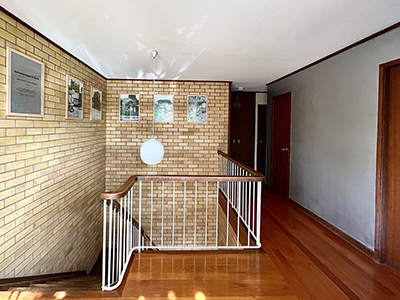
Beginning in the early 1990s and for many years thereafter, Burchill and McCamley documented the changing usage and urban status of a site in Berlin-Kreuzberg where the Berlin Wall had formerly stood. At this location, a Turkish-German family planted an outdoor vegetable and flower garden and constructed several sitting and garden structures. The artists were taken by the modernist art tropes, Bauhaus especially, and its beauty as a sculpture/assemblage. Over the last three decades, they have made several artworks relating to the site, including photographic series, slide works, videos, sculptures, and drawings. For their latest exhibition, Burchill and McCamley are presenting a generously spaced corner-hang of their print portfolio Bethaniendamm 0 (2003). A set of six duotone prints from the Kreuzberg work group, the photos are printed offset b&w with a superimposed layer of silver ink enlivening the image with a subtle sheen and sparkle. This introduction of silver, a modernist trope par excellence, underscores the constructivist or Bauhaus aesthetic, with this chroming a hint of how new technologies and industrial materials radically impacted modern art and architecture in the 20th Century. It is a nuance lent further emphasis here by the artists, who have painted the facing drywall silver. Indeed, the Bauhaus-inspired architecture of the two-level Pestorius Sweeney House is activated by the artists' installation and adds another important layer of reflectivity to the experience.
Janet Burchill and Jennifer McCamley have been working both individually and collaboratively since the early 1980s. Their practice embraces a diversity of media including photography, film, drawing, sculpture, and painting. Throughout Burchill and McCamley’s combined career, they have critically engaged with the history and forms of modernist art and its relationship to everyday life, as reconsidered through feminist, psychoanalytic, filmic, and spatial discourses. In 2019, the Heide Museum of Modern Art in Melbourne hosted Temptation to Co-Exist: Janet Burchill & Jennifer McCamley, the most extensive presentation to date of their practice, while next month the artists will participate in Embodied Knowledge: Queensland Contemporary Art at QAGOMA.
Olivier Mosset + Kyle Jenkins
4 May – 11 June 2022
Pestorius Sweeney House, Brisbane
We are pleased to announce a two-artist exhibition at the Pestorius Sweeney House, with works by John Nixon and Ian Anüll.
The latest in our series of exhibitions lauding the internationalism of John Nixon (1949–2020) pairs the Swiss artist Olivier Mosset (*1944) with the Australian artist/musician Kyle Jenkins (*1975).
Nixon was a great connector with and of people, often across the generational divide. For him, it was second nature to cultivate a dialogue between artists and to foster loose networks of engagement and support. A bit like an extended family, at its core was a commitment to taking a position in the culture, with the glue holding it all together being a common interest in abstract, minimal and conceptual art practices.
Take the case of Olivier Mosset and Kyle Jenkins here. In Mosset, we have an artist of international renown, initially for his conceptual questioning of authorship and originality with the BMPT group in the 1960s, while later, in the 1980s, he was associated with 'Radical Painting' (Marcia Hafif, Joseph Marioni, Günter Umberg, et al). Jenkins is much younger and less well-known. In the mid-1990s, he studied art in Sydney and it is there that he got to know John Nixon and, through him, met Mosset, who on a visit to Australia for a gallery exhibition in 2002, on Nixon's recommendation, engaged the then young artist to assist him in fabricating the artworks.
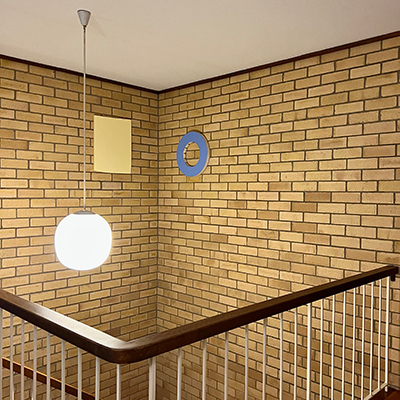
Since that time, the two artists have occasionally exhibited together, with Mosset a long-time resident of Tuscon, Arizona, while Jenkins is now senior lecturer in painting at the University of Southern Queensland in Toowoomba, near Brisbane. With their Pestorius Sweeney House exhibition, they honour Nixon by installing their works in a slightly staggered arrangement in the corner of the stairhall gallery, just as Nixon installed his final show there in 2019. However, in positioning their works higher on the walls, up near the ceiling and in the space of the pendant light, they conjure a certain ethereality that is forever in tension with the insistent objectness of these shaped and uninflected monochome paintings.
John Nixon + Ian Anüll
5 February – 2 April 2022
Pestorius Sweeney House, Brisbane
We are pleased to announce a two-artist exhibition at the Pestorius Sweeney House, with works by John Nixon and Ian Anüll.
As much as John Nixon (1949–2020) was an individual force of nature, of that there's no doubt, his activities didn't take place in a vacuum, but were shaped and supported by a complex international network of artist friends and colleagues. Nixon began to build this network during his earliest travels overseas in the 1970s. However, it was not until much later that its depth, diversity, and dynamism began to clearly emerge, mainly via anthologies of artist pages, including Kerb Your Dog (co-edited with John Young) and Z International Art, as well as through Nixon's exhibition curating, especially in the 1990s at Sydney's CBD Gallery, where he exerted influence over programming.
Of the many foreign artists Nixon drew into his orbit, there were several that he was close to. Some were of a slightly younger generation, such as the Danish artist Claus Carstensen (1957) and the Berlin-based Gerold Miller (*1961), while others from his own generation included the Croatian conceptualist Mladen Stilinović (1947–2016), the New York monochrome painter Joseph Marioni (*1943), and the Swiss conceptualist Ian Anüll (*1948). Photographic works by Anüll are displayed here in this exhibition alongside a group of Nixon's orange paintings from the late 1990s. Like the work of John Nixon, much of Ian Anüll's material production can be considered as a contemporary continuation or updating of Constructivism, with its geometric forms and tropes. That said, Anüll has consistently eschewed a signature style or aesthetic, which he views as market-driven and akin to a trademark. Indeed, many years ago now, he had the trademark symbol (the letter R inside a circle) inscribed on one of his upper front teeth, which when looked at in a mirror reflects as the Russian alphabet letter 'I'.
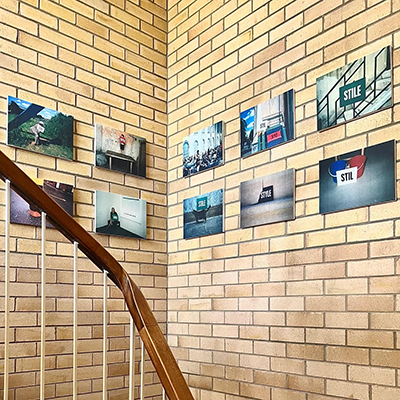
For the current exhibition, we are showing works from Anüll's 'STYLE' series, which were mostly made during the European summer of 1997 when there was a rare alignment of large contemporary art exhibitions, including the Venice Biennale, Documenta 10, and the decennial Sculpture Project in Münster. At these events, a bit like the actions of André Cadere in the 1970s, Anüll would spontaneously insert a canvas board bearing the word 'style' into momentary situations and quickly photograph them. The images were then printed on canvas and stretched over small wooden panels reflexively similar in size to the style boards themselves. Intuitive, playful, absurd, funny, serious, and sometimes even a little sad, these works challenge the viewer to think about the word 'style' and its possible meanings and implications in both the art context and the world beyond it.
Born in 1948 in Sempach (Lucerne), the artist lives in Zurich and has used the pseudonym Ian Anüll since 1969. Other than this, little is known about his biography and education, an artistic strategy aimed at avoiding conventional evaluation. Anüll began publishing artist books in the 1970s and since 1988 has exhibited with Zurich's Galerie Mai 36. Important exhibitions include Kunsthalle Zurich (1990), Bienal de São Paulo (1991), Kunstmuseum Solothurn (2003 and 2018), and Helmhaus Zurich (2010). The artist first travelled to Australia in 1995 for an exhibition organised by John Nixon at CBD Gallery. This was followed by exhibitions at David Pestorius Gallery in Brisbane in 1996 and 1997, and in Berlin in 1999.
Andreas Exner
8 November – 18 December 2021
Pestorius Sweeney House, Brisbane
A taste of 30-years’ work from the studio of Frankfurt-based artist Andreas Exner (*1962) is now on view at the Pestorius Sweeney House.
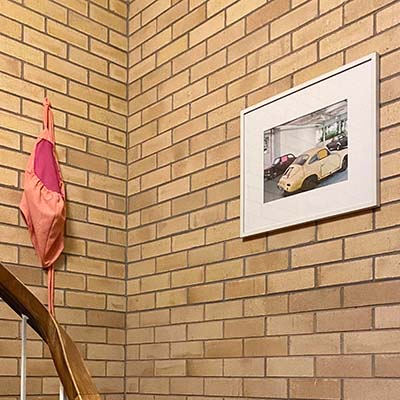
Exner emerged on the international art scene in the early 1990s as part of a new generation concerned with painting in the extended field, a practice that exceeds the conventions of painting while also critically evolving the tradition in the aftermath of Conceptual Art. The artist's clothing pieces, an ongoing series that brought him to prominence with the support of high-profile curators such as Kasper König and Hans-Ulrich Obrist, are a prime example, appearing to be both painting and sculpture and simultaneously neither of these things.
Like the 'stoffbilder' of Blinky Palermo, an artist Exner was very interested in as a student (and why he chose to study at Frankfurt's Städelschule with Palermo's friend Jörg Immendorff), his clothing pieces seem to at once embrace and reject painting. With their subtle combinations of found garment and coloured swatch roughly hand-sewn together, they have a strange presence, which is not so much indebted to Duchamp's readymades but to the Russian Constructivist quest for functionality. Similarly, Exner's paintings for car windows, the work group he humorously calls the 'Applied Monochrome Paintings', pit the handmade against the industrial and continue the literalisation of Ellsworth Kelly's shaped canvas, bringing it into a more productive engagement with everyday life.
Andreas Exner first visited Australia in 1996 for solo exhibitions at the David Pestorius Gallery and the legendary Sydney artist-run CBD Gallery. Since then, he has exhibited here many times and developed a deeply productive relationship with Australia and its artists, beginning with the late John Nixon, who curated his CBD Gallery show. Other Australian artists who Exner has worked closely with include A.D.S. Donaldson on their series of ALDI exhibitions in 1999-2000 [Exner's ALDI Curtain (1999) is now in the collection of the Institut für Auslandsbeziehungen, Stuttgart]; Elizabeth Newman, who in 2006 wrote a text on his art; Rose Nolan, who showed alongside Exner in a two-artist exhibition at Melbourne's VCA Margaret Lawrence Gallery in 2011; and Paul Bai, whose 2019 catalogue for his installation at Ankles in Sydney was designed by Exner. Exner's latest exhibition is something of a retrospective, comprised as it is of clothing pieces from 1990 and 2015, car window paintings from 2006 and 2011, a colour photograph from 2005, a screenprint from 2008, and a selection of the artist's much-admired A5 format offset-printed booklets from the 1990s. While hardly a comprehensive overview, it does provide a glimpse of Exner's achievement over three decades and, hopefully, prompts others to take the next step.
Brooke Ferguson: Mercury
5 December 2020 — 6 February 2021
Pestorius Sweeney House, Brisbane
We are pleased to announce a new exhibition for the Pestorius Sweeney House by Brisbane artist Brooke Ferguson (*1989).
Ferguson's work is shaped by a fascination with crossovers in art, music, literature and marginal histories relating to the ongoing critique of Modernism. Non-discipline specific, research orientated and often collaborative, her recent work reflects an art historical self-consciousness and gestures towards what is at stake when drifting inside and outside institutional settings.
Initially gaining a BFA(Hons) at the Queensland University of Technology, in 2017 Ferguson undertook further studies at the Maumaus Independent Study Program in Lisbon and since then has lived in Brussels, which is where the roots of her latest exhibition are located. At the same time, the show betrays the artist's origins in regional Queensland. In this regard, during the early stages of the COVID19 pandemic, Ferguson took out a half-page advertisement in Mackay's Daily Mercury newspaper and reproduced ‘The Premature Burial’ (1854) by Antoine Wiertz (1806–1865). With this gesture she questions how this Belgian painter, whose unconventional practices, including his refusal to deal with the art market and creation of a house museum devoted to his work, may prefigure Conceptual strategies of art making, display and dissemination.
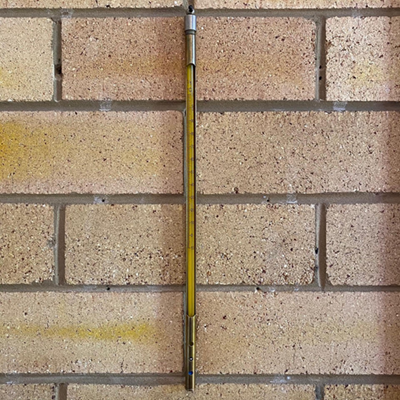
For her Pestorius Sweeney House exhibition, Ferguson continues this contemporary complexification of the role of the artist. Installing a stack of her intervened-in Daily Mercury in the entry hall adjacent to a wall-mounted mercury thermometer, she prompts us to consider the temperature of today, reflect upon the legacy of a recent past, and to imagine possible futures (by mere coincidence, the intervened-in Daily Mercury was the last Saturday print edition prior to News Corp shifting most Australian regional newspapers to an online-only format). This highly reflexive piece also conjures a curious comment once made about the Wiertz Museum, that it was "not art, but a public newspaper”. In addition to her installation, a display copy of Ferguson's intervened-in newspaper will be available to be handled by visitors to the exhibition, which shall be open by appointment only. There will, however, be a finissage event attended by the artist on the evening of Saturday 6 February 2021.
John Nixon Memorial Exhibition
7 November 2020, 1–5pm
Pestorius Sweeney House, Brisbane
On 7 November, the Pestorius Sweeney House will host a special memorial exhibition celebrating the life of John Nixon (1949–2020), who died recently following a year-long battle with Leukemia.
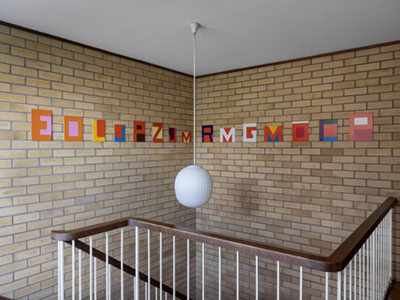
In the early 1980s, when John first lived in Brisbane, he pioneered the one-day show format. A manifestation of the conceptualist devaluing of established cultural hierarchies, the one-day show was a radical challenge to the protocols of production, display and dissemination. It was also closely related to the DIY actions of punk and the cultural collapse and reconstruction this entailed. John saw the one-day show as akin to the punk gig, which was invariably a brief and intense experience, and the idea that "you either go to see it now or you miss out". Subverting the rule of the artist's CV and the deeply entrenched view of the exhibition as hard-won achievement, in the 1980 and '81 years John presented more than 70 of these short duration shows in and around Brisbane. Initially, a derelict wool store in the city was the locus for a series of guerrilla interventions. The artist's flat in Spring Hill was also a frequent site. Other venues included a McDonalds eatery, a Chinese restaurant, and the studio of Robert MacPherson, who had numerous 'Q Space' shows at this time.
This special one-day memorial show wants to reflect upon that moment forty years ago, when John was at his most dynamic and driven. At the same time, it wants to look forward via a presentation of the artist's typographic paintings, the celebratory works dedicated to his daughter, Emma, and to the newborn children of his friends. With their composition determined by the infant's first initial, John commenced making these small paintings in 1996 and continued to make them, as gifts to their subjects, until the end of his life. Mostly realised in only two colours, with orange always present and predominant, they are bright and uplifting, conjure new beginnings, a sense of optimism and hope for the future.
In addition to the display, at 3pm David Pestorius will lead the panel discussion '1980-1981: John Nixon in Brisbane', with the painter Jenny Watson and songwriter Robert Forster, while the Viennese artist Heimo Zobernig, whose work John was the first to promote in Australia, will create a special commemorative poster that will be published in co-operation with Melbourne’s Negative Press.
Paul Bai
15 July — 12 September, 2020
Pestorius Sweeney House, Brisbane
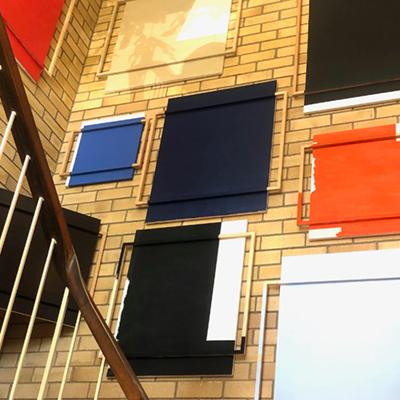
A few years ago, Brisbane artist Paul Bai began to make a strange kind of abstract painting, one that clearly acknowledges the traditions of painting — the rectilinear format and the frame foremost amongst them — while at the same time playfully pulling the rug out from underneath these things. In the process, Bai takes the historical primacy of painting as a kind of window onto the world and subjects this relation to scrutiny, offering the viewer a new way to think and cipher reality.
Bai's 'frame paintings', as these works are sometimes called, commence with the artist fixing a thin pine frame to the surface of a pre-primed canvas panel. The frame is approximately the same dimensions as the panel, but it is fixed centrally at right-angles. The overall shape then is a cross, which Bai proceeds to paint in a seemingly perfunctory manner that vacillates between the formal or geometric and the informel.
Accompanying Bai's Pestorius Sweeney House installation, which takes a cue from Malevich's famous St. Petersburg hang, is a short essay by Davina Li, who sees the artist's methodology as indebted to his Chinese origins:
"Drawing on Bai’s understanding of Chinese calligraphy, his paintings concentrate on how the pause — manifested as gaps, breaks, and voids in colours, lines and volumes — affects the way absence defines presence just as much as presence defines absence. As viewers, we activate, find, and experience this pause when we stand before each work and comprehend the small jumps from wooden frame to paint; from paint to canvas; from canvas and its wooden frame to the painting’s immediate space; and from the painting’s immediate space to our space that we inhabit, which is also the space in which the painting is displayed."
Paul Bai was born in 1968 in Tianjin, China. In 1988 he migrated to Australia, where he studied art at the Queensland College of Art and in 1995 was awarded a Bachelor of Visual Art with Honours (in 2015 Bai was awarded a PhD from the same institution). Since 2001 Bai has regularly exhibited at the Pestorius Sweeney House. The artist has also had solo shows at Sydney's 4A Centre for Contemporary Asian Art and Brisbane's Institute of Modern Art. In addition, Bai's work has been included in thematic and survey exhibitions at important public institutions, including QAGoMA, ACCA, MUMA, UQ Art Museum, Griffith University Art Museum, Singapore Art Museum and Guangdong Museum of Art. In 2019, his installation for Ankles in Sydney was the subject of a monograph published by Frankfurt's Kann-Verlag. That same year Bai collaborated with the celebrated First Nations artist Archie Moore on Here We Are, a site-related installation at The Soylent Spot in Brisbane. The artist is currently working on a Bauhaus history project for the Museum of Brisbane, which is scheduled to open in September.
Melinda Harper
18 April — 20 June, 2020
Pestorius Sweeney House, Brisbane
During an interview conducted towards the end of his life, the American minimalist Donald Judd (1928–1994) remarked "I think colour is probably the most important aspect of art in this century. It's the one that's strongest in keeping the art from turning backward. Everybody wants to turn it backward, and I think the colour is the toughest in resistance."
The Melbourne abstract artist Melinda Harper (*1965) would undoubtedly concur with these sentiments. However, unlike Judd, Harper has steadfastly adhered to the traditional formats and materials of painting, now for well over 30 years. Which is not to suggest that the artist's devotion to the rectilinear panel and oil paint constitutes the kind of "turning backward" that Judd was so dismissive of. On the contrary, in Harper's hands these age-old conventions have always been marked by a certain criticality. Early in her career, for instance, it could be seen in the use of rough offcuts of Masonite or the cheap mass-produced canvas panels commonly associated with amateur painters. Then there is the unorthodox use of thick impasto oil paint in combination with masking tape to build up her geometric compositions, which come together slowly, in a bits and pieces, but also in a somewhat haphazard experimental manner too. At the end of the day, the slick finish of hard-edge abstraction and its fussy academic successors take a hit where it hurts.
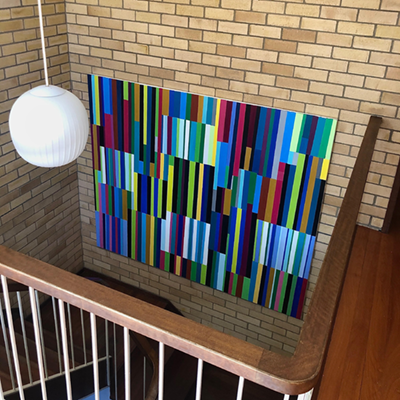
This is Melinda Harper's first solo exhibition in Brisbane since her mid-career survey at Melbourne's Heide Museum of Modern Art in 2015. The focus of the show is a large painting from 2017, which has been installed on its own in the voluminous space of the stairhall gallery at the Pestorius Sweeney House. The painting consists of fractured multi-coloured vertical stripes, with an overall preponderance of green and out of which emerge a number of blocky forms that push and pull as well as hunt the eye around the picture plane. This reflexive dynamism is also carefully controlled by the judicious deployment of white segments, which is then accentuated by the presence of white and off-white forms in the surrounding space (the ceiling, pendant light, balusters, etc). In the result, art and architecture momentarily collapse into one another, something which has long been an ambition of abstract artists.
Jan Timme
7 February — 28 March, 2020
Pestorius Sweeney House, Brisbane
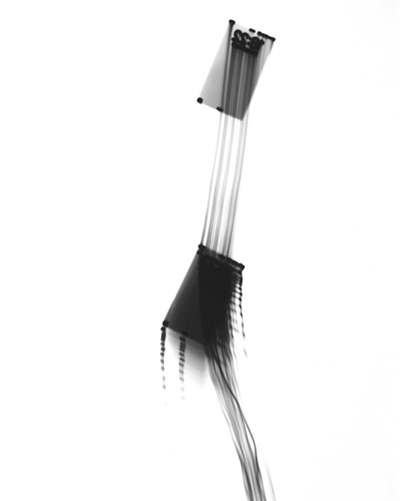
In "Vision in Motion" (1947), Moholy-Nagy summarised the avant-garde embrace of cameraless photography – the placing of objects on photochemical paper and then exposing it to light – like this: "Man Ray calls his cameraless photographs, 'rayograms'; Schade [sic] his photos without camera, 'shadograms'. When I started out in 1921 with my cameraless photographs I suggested the name 'photogram', which has been adopted since by most people".
Moholy's light ridicule of his colleagues and their self-aggrandising puns is hard to fault. After all, the photogram is as old as photography itself, while Moholy was its most innovative early exponent and great theorist. His photograms, with their disorienting inversions and strong sense of temporality could, he proclaimed, alter our perception and even spark a fresh appreciation of spatial and social relationships.
Jan Timme's photograms are a kind of tribute to Moholy, but also to Berlin, the city where he has lived since 2004 and which was an important locus for early avant-garde engagement with this dematerialising artform. Recalling the explosive grisaille paintings of K.O. Götz and K.R.H. Sonderborg, Timme's works are made with an iPhone. The most ubiquitous and affecting of contemporary objects, Apple's revolutionary smartphone here is everything at once: object, subject, source of illumination, a clock that records the event, and, of course, it's a camera too.
First exhibited in 2017 at the Galerie Nagel Draxler in Berlin, Timme calls these dramatic time-infused images "Lagaffographs", after Gaston Lagaffe, the Belgian cartoon character whose layabout yet imaginative persona is something of a touchstone for the artist (his large drawing for the Pestorius Sweeney House stairhall in 2018 also took inspiration from a Gaston cartoon). It is a naming that also conjures the ghost of Moholy and his delightful dig at the egos of artists who crave to be seen as the source of invention and influence.
John Nixon: Two paintings for a stairwell
4 September – 21 December 2019
Pestorius Sweeney House, Brisbane
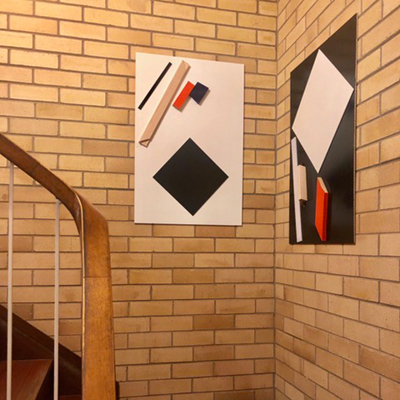
On the eve of John Nixon's 70th birthday, we are delighted to present the Melbourne artist's first solo exhibition in Brisbane in over 20 years.
Although Nixon hasn't lived in Brisbane for three decades, it's a city he has a long and indelible connection to, mainly on account of the years he spent here in the early 1980s as Director of the Institute of Modern Art. It was a time of intense activity, the post-punk years, when art and rock music all but collapsed into one another, with Nixon collaborating with numerous local artists and musicians, including The Go-Betweens, who have acknowledged the importance of this interaction.
It was also when Nixon began to up the ante on the formal and conceptual vocabulary that we have come to associate with the artist. Conjuring the utopian moment of the Russian avant-garde and conjoining modern art's most radical developments – the readymade and the monochrome – Nixon's vast production over the last 40 years evinces not only great drive and dexterity, but also a joyousness that rarely attracts comment, perhaps because of a certain dourness in the way the artist tends to install his frequent exhibitions.
With his project for the Pestorius Sweeney House, Nixon eschews this expectation, playfully installing an example of his latest work, the "Paired Paintings", in a staggered formation that serves to echo the architecture of the stair hall gallery. The reflexivity this generates is then doubled by the dynamic inter-related compositions, forms and materials that comprise the two paintings. A seemingly random selection and disposition of off-cut elements scavenged from the workshop floor; they are, in fact, carefully composed constructions, with the dominant square/diamond motif another subtle reminder of an architecture in which the right-angle and square are ever present.
Dave Hullfish Bailey + Sam Watson
CityCat Project 2019
18 May – 20 July 2019
Pestorius Sweeney House, Brisbane
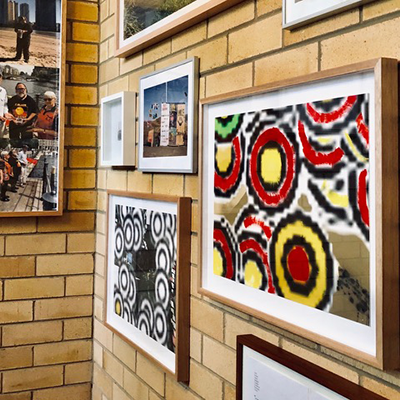
To complement the presentation of Dave Hullfish Bailey and Sam Watson’s CityCat Project in the Brisbane Art Design exhibition now at the Museum of Brisbane, the Pestorius Sweeney House is hosting the first historical overview of the project.
A video co-produced with Heimo Zobernig in 2017 and encountered on entry offers an experimental documentary of the first four iterations of the Maiwar Performance. The central element of the CityCat Project, the performance was first staged in 2006. Chronology, however, is eschewed in the survey, which forges nonlinear connections between the disparate elements, themes and impulses that have generated the works themselves.
Large photographs of the residual wakes created by CityCat ferries during the Maiwar Performance in 2012 provide an oblique record, while calling attention to the event as an act of marking territory. The converse impulse — to destabilize colonial claims to the land — informs the most recent works: a series of digital prints based on satellite mapping of South East Queensland’s cadastral survey control marks.
Other works situate the Maiwar Performance in broader spatial and historical contexts: a found image of a young Sam Watson working at the Aboriginal Embassy in Canberra in 1972 embeds the CityCat Project within longer struggles for Aboriginal land rights. Expanding the geographic frame, a 2016 photograph shows the Aboriginal flag flying near the entrance to protest camps on the Standing Rock Sioux Reservation in North Dakota.
Taken together, what emerges is less a comprehensive history of the project than a meditation on its processes, networks of relevance, and modes of collaboration. While Bailey’s methods — word play and language games, analogical experiments, conflations of words and their material referents, etc. — have decidedly Western roots, the circuits they construct between differing orders of meaning suggest conceptual and textural affinities with Watson’s own writing. In particular the narrative universe of The Kadaitcha Sung (Penguin, 1990), in which ancient culture, the colonial past and contemporary reality are fluidly superimposed, comes to mind.
Green Room: Paul Bai, Stephen Bram, Gail Hastings, Joseph Marioni, Jan Timme
2 March – 27 April, 2019
Pestorius Sweeney House, Brisbane
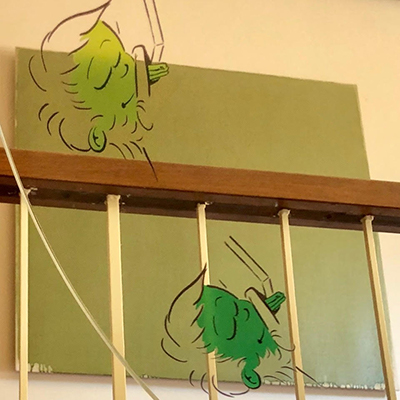
The Brisbane architect and designer of the Sweeney House (1966), Geoffrey Pestorius, was known to say “There are only two colours: green and dark green.” It therefore, perhaps, comes as no great surprise to learn that upon his engagement to journalist Geraldine Sweeney he gave her an emerald ring.
Of course, green was not the only colour that Geoff Pestorius favoured. He was also partial to a mustard yellow, which can be seen in the carefully chosen brickwork at the Sweeney House as well as in items of furniture that he either had made or otherwise acquired. Yet it was green that moved him most and it is everywhere present, both inside and out, at the Sweeney House, which since 1999 has been the site of numerous exhibitions and events held under the Pestorius Sweeney House banner. To celebrate this milestone, we are re-exhibiting a number of artworks that were originally shown at the Pestorius Sweeney House in days gone by and where the colour green is predominate.
Commencing with Jan Timme’s colour wheel clock, its naturalistic green hour markers chime visually as Joseph Marioni’s exquisite ‘Green Painting’ (2013) comes into view. The role of time and the self-reflexive experience of architectural space also figure in Gail Hastings’ ‘Encyclopaedia of Contemporary Art’ (1996). A pencil and watercolour drawing in two parts, the Hastings artwork takes Varvara Stepanova’s famous fabric patterns from the 1920s as its point of departure, while a small two point perspective painting from 2003 by Stephen Bram continues this spatio-temporal thematic. To round out the display, Brisbane artist Paul Bai has made a new artwork especially for the show.
Gabriel Poole: Photographer
12 October – 24 November, 2018
Pestorius Sweeney House, Brisbane
The architecture of Gabriel Poole is well-known, especially his lightweight and environmentally sensitive houses on Queensland’s Sunshine Coast. In 1991, Poole's Tent House at Eumundi received the Australian Institute of Architects’ Robin Boyd Award for Residential Architecture, while in 1998 he was awarded that organisation’s Gold Medal, its highest honour. A decade on, Poole's work was presented as precursory in a major survey of recent local architecture at the Queensland Art Gallery.
Less well-known is Poole’s architectural photography, which is the subject of this exhibition. Focusing on a group of important courtyard houses that Poole photographed for submissions to the Institute’s annual awards in the 1960s, the show features the architect’s family home, the Poole House (1962), designed while still a student draftsman in Robin Gibson’s office; the award-winning Mocatta House (1965, above), which Poole also designed while working for Gibson; Geoffrey Pie’s Ravenscraig 2 House (1965); and Geoffrey Pestorius’ Sweeney House (1966).
It is a significant grouping of vintage photographs: the original silver gelatin prints made by a now celebrated architect for an important occasion, they speak of a certain milieu of emerging Brisbane practitioners in the post-war period and how they adapted Mies van der Rohe’s Bauhaus teachings to the subtropical climate and topography of South East Queensland. Rejecting the rambling tin and timber stump-house, the so-called Queensland idiom, they created a new rectilinear ground-hugging architecture, predominantly of glass and masonry. With site and context, house and garden, inside and out, all precisely integrated within a spatially fluid, light, open and cool plan, these houses were compact and more in tune with local conditions than any of the regional vernacular building precedents.
Gabriel Poole’s photographs for also lend credence to the conceit that there was a Brisbane School of modern architecture and that it reached its apotheosis with the architects and houses the subject of this exhibition.

Jan Timme: Clouds
12 October – 24 November, 2018
Pestorius Sweeney House, Brisbane
It is with great pleasure that we announce the first exhibition in Australia by the Berlin-based artist Jan Timme (*1971 in Stuttgart).
In 2007, Timme’s work was included in the pleonastically titled group exhibition ‘Romantic Conceptualism’. Curated by Jörg Heiser at the Kunsthalle Nürnberg, it sought to debunk the cliché that Conceptual Art is anti-romantic in nature and, its reciprocal, that Romantic Art is anti-conceptual. Then, in 2011, in an article for Artforum, the art historian and critic André Rottmann wrote of how Timme’s engagement with post-Duchampian practices is marked, not by nostalgia, academicism or simple emulation, but by a lightness and play that, dare we say it, approaches the condition of poetry. It is certainly true that the artist has bent and twisted pop song lyrics, including those of Brisbane group The Go-Betweens, to his own reflexive ends, with Timme’s diverse production since 1996 the subject of Endless Night, an exquisitely detailed 352 page monograph published by Koenig Books in 2017.
For his Brisbane exhibition, Timme takes the temporal experience of the Pestorius Sweeney House, with its Miesian flow and blurring of inside and out, as a springboard. The show’s title, ‘Clouds’, evokes multiple associations, amongst other things to Gabriel Poole’s dramatic 1967 photograph of the house on the cover of the small book devoted to it; to the predominantly Minimal-Conceptual program of the house over the last two decades (here clouds are the thought bubbles of cartoons, a Popist tradition that Timme is particularly adept at); and to the ever-changing conditions of natural light and the temporality this brings to the installation. All of these things find form in a new body of work that joins with the architecture in a reflexive doubling of its theatricality and discursive situation.
Another aspect of Timme’s Brisbane exhibition is its engagement with the discoveries of his fellow countryman, Sigmar Polke (1941–2010), whose 1981 travels in Australia’s Central Desert led him to a heightened appreciation of colour, especially purple, and its materiality. Timme recently retraced Polke’s steps with a view to experiencing for himself what its Aboriginal inhabitants have known for thousands of years — as the watercolours of Albert Namatjira (1902-1959) and his Arrernte followers so powerfully attest — and what Polke once mysteriously described as “an entirely abstract affair that you only get in this part of the world”.